
The Success of Assimilation: Why Some Aboriginal Families Came Home to Doubt Instead of Welcome - William Cooper's Legacy, the Bringing Them Home Report & the Modern Debate About Aboriginal Identity

By NATSIC-AS – National Aboriginal and Torres Strait Islander Corporation – Advocacy Service
"The greatest success of assimilation was not making Aboriginal people disappear. It was convincing generations that survival depended upon hiding who they were."
Introduction
Australia's history is filled with contradictions.
For more than a century governments implemented policies designed to absorb Aboriginal people into the broader population. Aboriginal children were removed from their families, languages were suppressed, cultural practices were discouraged, and countless people were taught that identifying as Aboriginal would bring discrimination, poverty, exclusion or the removal of their own children.
Today, many descendants of those same families are searching for the identity that previous generations believed they had no choice but to conceal.
Yet some are met, not with understanding, but with suspicion.
Some are told they are "too late."
Others are told they "don't know enough."
Some are criticised because they were not raised in community.
Others are asked why they are only identifying as Aboriginal now.
These questions deserve careful consideration.
But perhaps there is a more important question.
Why were so many Aboriginal families absent from community in the first place?
The historical evidence suggests the answer is uncomfortable.
For decades Australian governments worked deliberately to create exactly that outcome.
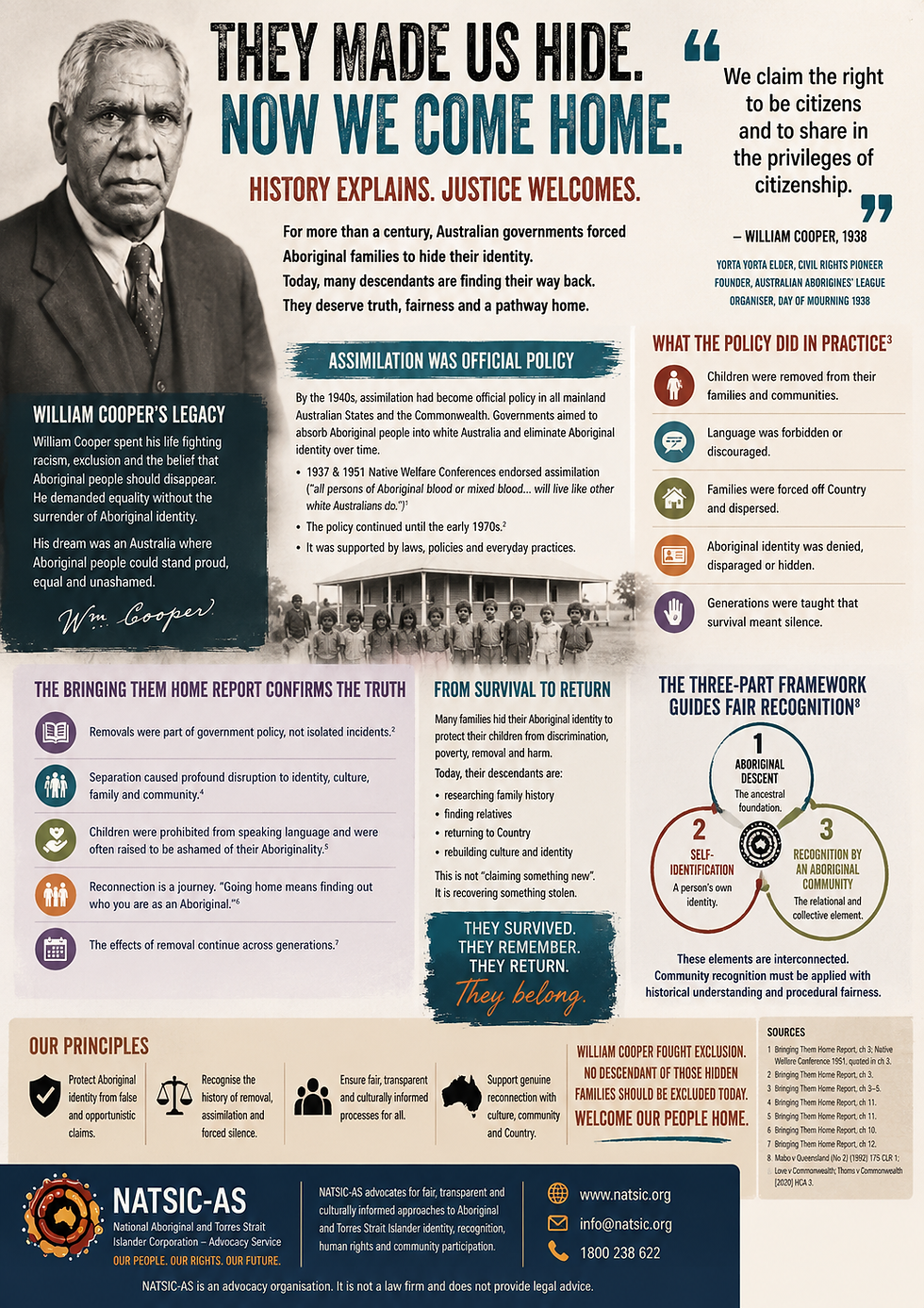
William Cooper's Australia
William Cooper (c.1861–1941) lived through one of the most oppressive periods in Australian history.
Born on Yorta Yorta Country along the Murray River, Cooper witnessed the gradual development of policies that increasingly controlled almost every aspect of Aboriginal life.
His generation experienced:
forced removals from traditional lands;
the establishment of Aboriginal Protection Boards;
restrictions on movement;
controls over marriage;
exclusion from voting;
segregation;
institutional discrimination;
the growing influence of policies that ultimately became known as assimilation.
Unlike many political leaders of his era, Cooper had little formal education. Yet he became one of the most significant Aboriginal advocates Australia has ever produced.
He helped establish the Australian Aborigines' League, organised petitions to King George V seeking Aboriginal representation in Parliament, and led the historic Day of Mourning protest on 26 January 1938.
Throughout his life Cooper challenged one central idea:
That Aboriginal identity should disappear.
His campaign was never simply about legal equality.
It was about ensuring Aboriginal people could continue to exist as Aboriginal people.
Assimilation Was Not an Accident
Many Australians understand assimilation as encouraging Aboriginal people to "fit in."
History paints a different picture.
By the middle of the twentieth century assimilation had become official government policy throughout Australia.
The policy sought to ensure Aboriginal people eventually lived as members of the non-Aboriginal population, adopting European customs, values and lifestyles while Aboriginal cultural identity gradually disappeared.
The Bringing Them Home Report records that assimilation became official Commonwealth and State policy following the 1937 and 1951 Native Welfare Conferences, where governments resolved that Aboriginal people should ultimately attain the same manner of living as other Australians while abandoning separate cultural existence.^1
The policy was not merely social.
It was administrative.
Children were removed.
Communities were dispersed.
Language was discouraged.
Family structures were disrupted.
Traditional authority was weakened.
The consequences continue today.
The Removal of Identity
The National Inquiry into the Separation of Aboriginal and Torres Strait Islander Children from Their Families found that governments removed children for many reasons that would never have justified removal in non-Indigenous families.
The Inquiry concluded that the removals were not isolated welfare interventions.
They formed part of broader policies aimed at absorbing Aboriginal children into white Australian society.^2
The report repeatedly documents children being:
prohibited from speaking their own language;
discouraged from identifying as Aboriginal;
separated from siblings;
denied knowledge of family history;
prevented from maintaining cultural practices;
raised believing they were not Aboriginal at all.
Many former residents of institutions described growing up ashamed of their Aboriginality because they had been taught that being Aboriginal meant being inferior.
Others did not discover they were Aboriginal until adulthood.
The Inquiry concluded that the destruction of identity was one of the most profound consequences of removal.^3
Hiding Became a Survival Strategy
Government policy did not operate in isolation.
Families observed what happened to neighbours.
Children disappeared.
Workers lost employment.
People experienced discrimination simply because they were Aboriginal.
The rational response was often silence.
Many parents concluded:
"If nobody knows we're Aboriginal, perhaps our children will be safer."
This was not abandonment of culture.
It was an act of protection.
Across Australia families:
concealed ancestry;
adopted alternative ethnic identities;
stopped teaching language;
avoided discussing Country;
discouraged children from identifying publicly.
Some families maintained cultural knowledge privately.
Others lost it almost entirely.
Neither outcome should surprise us.
Both were foreseeable consequences of government policy.
The Bringing Them Home Report Explains Modern Reconnection
One of the Inquiry's most significant findings concerns identity itself.
The report explains that separation from family resulted not merely in emotional trauma but in profound disruption to personal identity, cultural belonging and community participation.
Many participants described spending decades attempting to rediscover who they were.
Reunion was described as only the beginning.
Learning family history.
Finding Country.
Meeting relatives.
Understanding language.
Rebuilding community relationships.
The Inquiry recognised these processes as essential components of healing.^4
Importantly, the report never suggests that people disconnected by government action somehow ceased to be Aboriginal.
Rather, it acknowledges that identity survives despite attempts to destroy it.
William Cooper's Legacy
William Cooper spent more than fifty years arguing that Aboriginal people deserved equality without surrendering their identity.
His campaigns consistently rejected the assumption that Aboriginal people should disappear into white Australia.
His work anticipated later human rights principles recognising the importance of cultural identity.
Although Cooper died in 1941, before the emergence of modern international human rights law, his philosophy aligns remarkably closely with principles later reflected in:
Article 27 of the International Covenant on Civil and Political Rights;
Articles 8, 20 and 30 of the Convention on the Rights of the Child;
Articles 8, 11, 13 and 33 of the United Nations Declaration on the Rights of Indigenous Peoples.
Each recognises that Indigenous peoples possess collective rights to maintain identity, culture and community.
The Great Irony
Today many Aboriginal descendants begin searching family history.
They discover mission records.
Protection Board files.
Birth registrations.
Death certificates.
Old photographs.
Oral histories.
DNA alone cannot establish Aboriginal identity.
Nor should it.
But documentary evidence frequently confirms what previous generations concealed.
Then something extraordinary happens.
People who are attempting to recover the identity governments once sought to erase are sometimes criticised because that erasure was successful.
They are asked:
Why weren't you raised in community?
Why don't you know your language?
Why didn't your grandparents identify?
History already provides the answer.
Because governments worked extraordinarily hard to produce exactly that outcome.
Community Recognition Matters
None of this means community recognition is unimportant.
Quite the opposite.
Aboriginal identity has never been solely individual.
It is relational.
Community acceptance reflects responsibilities as well as ancestry.
Communities have entirely legitimate reasons for protecting themselves from false claims.
Fraudulent assertions of Aboriginality can displace genuine Aboriginal people from employment, scholarships, representative positions and cultural authority.
Verification is therefore essential.
However, verification must also recognise history.
Where governments deliberately disrupted community connection, decision-makers should avoid treating that disruption as evidence against the descendants themselves.
Otherwise the historical injustice becomes self-perpetuating.
The Three-Part Test
Australian courts have long recognised three interconnected considerations in determining Aboriginal identity:
Aboriginal descent.
Self-identification.
Recognition by the Aboriginal community.
The High Court discussed this tripartite approach in Mabo v Queensland (No 2) and again in Love v Commonwealth; Thoms v Commonwealth, emphasising that Aboriginal identity is not purely biological but also social and cultural.^5
Importantly, community recognition should not become an impossible barrier for descendants whose families were removed, dispersed or compelled to conceal identity through government policy.
Community recognition should involve genuine engagement, historical understanding and procedural fairness.
It should not operate as punishment for assimilation's success.
A Better Understanding
Perhaps we have been asking the wrong question.
Instead of asking:
"Why weren't you raised in culture?"
We might ask:
"What happened to your family?"
That question changes everything.
Because history provides the answer.
Government policies removed children.
Discouraged language.
Destroyed family networks.
Encouraged silence.
Rewarded assimilation.
Punished Aboriginal identity.
The absence of cultural continuity is therefore often evidence of historical injustice—not evidence that Aboriginal identity ceased to exist.
William Cooper's Unfinished Legacy
William Cooper did not spend fifty years fighting for Aboriginal rights so future generations could inherit new forms of exclusion.
His vision was larger.
He believed Aboriginal people deserved equality while remaining Aboriginal.
That vision remains unfinished.
Protecting Aboriginal identity from fraudulent claims is essential.
Equally essential is ensuring that descendants of families damaged by assimilation are assessed with historical understanding, procedural fairness and respect.
To ignore history risks completing the very project assimilation sought to achieve.
NATSIC-AS Position
NATSIC-AS supports rigorous, evidence-based processes for confirming Aboriginal identity.
We reject fraudulent claims.
We equally reject processes that disregard the documented effects of assimilation, child removal and cultural suppression.
The Bringing Them Home Report demonstrates that governments intentionally disrupted Aboriginal family structures, community participation and cultural continuity.
Those historical realities must inform contemporary decision-making.
Where descent can be established, self-identification is genuine and community relationships are being honestly rebuilt, history should be understood—not used as another barrier.
William Cooper fought for a future where Aboriginal people no longer needed to deny who they were.
The descendants of families who survived by hiding should not be condemned because their ancestors did exactly what history taught them was necessary to survive.
References
Commonwealth of Australia, Bringing Them Home: Report of the National Inquiry into the Separation of Aboriginal and Torres Strait Islander Children from Their Families (Human Rights and Equal Opportunity Commission, 1997), especially chapters discussing assimilation policy and the 1937 and 1951 Native Welfare Conferences.
Bringing Them Home, chapters addressing the historical removal policies and government objectives.
Bringing Them Home, chapter on the effects of removal on identity, culture and family.
Bringing Them Home, chapters concerning reunion, healing and reconnection.
Mabo v Queensland (No 2) (1992) 175 CLR 1; Love v Commonwealth; Thoms v Commonwealth [2020] HCA 3.
Australian Human Rights Commission, Bringing Them Home (1997).
United Nations Declaration on the Rights of Indigenous Peoples, GA Res 61/295, UN GAOR, 61st sess, 107th plen mtg, Agenda Item 68, UN Doc A/RES/61/295 (13 September 2007).
International Covenant on Civil and Political Rights, opened for signature 16 December 1966, 999 UNTS 171 (entered into force 23 March 1976).
Convention on the Rights of the Child, opened for signature 20 November 1989, 1577 UNTS 3 (entered into force 2 September 1990).


Comments