
Aboriginality Certificates: Identity, Gatekeeping, and the Fight for Fair Access

Across Australia, one of the most contested and misunderstood issues facing Aboriginal and Torres Strait Islander peoples today is the process of proving something that, in truth, should never need to be proven—identity.
The requirement to obtain an “Aboriginality Certificate” or formal confirmation of identity has become embedded across government, employment, and institutional frameworks.
While intended to provide administrative certainty, the system itself has evolved into something far more complex—and, at times, deeply problematic.
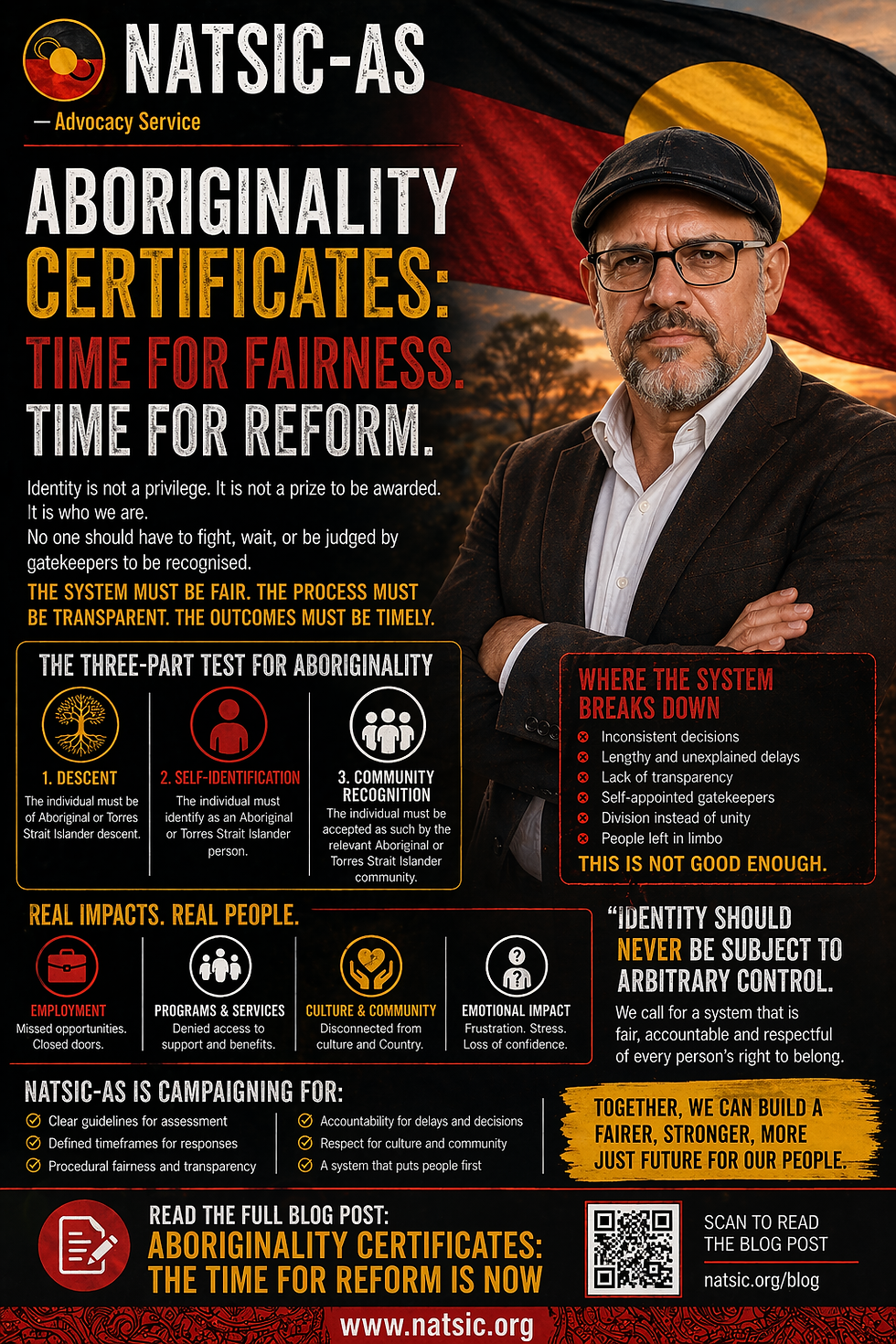
The Three-Part Test for Aboriginality
At law and in policy, Aboriginality is generally determined through what is commonly referred to as the three-part test:
DescentThe individual must be of Aboriginal or Torres Strait Islander descent.
Self-IdentificationThe individual must identify as an Aboriginal or Torres Strait Islander person.
Community RecognitionThe individual must be accepted as such by the relevant Aboriginal or Torres Strait Islander community.
This framework has been affirmed in various legal and administrative contexts and remains the standard applied across most institutions.
On its face, it appears straightforward.
In practice, it is anything but.
Where the System Begins to Break Down
The most contentious element is not descent. It is not even self-identification.
It is community recognition.
This requirement has increasingly become a point of friction, delay, and, in some cases, exclusion. Local organisations—often Land Councils or community bodies—are tasked with assessing applications and determining whether an individual is “recognised.”
What has emerged in recent years is a growing concern about:
Inconsistent decision-making
Lengthy and unexplained delays
Lack of transparency in assessment processes
Informal or subjective standards being applied
In some cases, individuals with clear genealogical connection and longstanding identification face significant barriers in obtaining recognition. In others, the process appears to hinge not on objective criteria, but on internal dynamics, relationships, or gatekeeping attitudes.
The Rise of Gatekeeping Concerns
There is an increasing perception—rightly or wrongly—that elements within the system have become self-appointed arbiters of identity.
This creates a serious tension.
On one hand, community recognition is intended to preserve cultural integrity and ensure authenticity.
On the other, when exercised without consistency, accountability, or timeliness, it risks:
Excluding legitimate members of community
Undermining confidence in the system
Creating division where there should be unity
Placing individuals in a position where they must “prove” themselves to others
Identity is not something that should be subject to arbitrary control.
Yet for many, that is precisely how the process is experienced.
The Practical Consequences
The implications are not abstract.
Delays or refusals in obtaining confirmation of Aboriginality can directly impact:
Access to employment opportunities
Participation in identified positions
Eligibility for programs and services
Engagement with cultural and community initiatives
For individuals already navigating complex personal, professional, and cultural landscapes, these barriers can be both frustrating and deeply personal.
NATSIC-AS Position: Accountability and Timeliness
NATSIC-AS is increasingly engaging with this issue as part of its broader advocacy mandate.
The position is clear:
Processes that determine identity must be fair, transparent, and timely.
At a minimum, there must be:
Clear guidelines for assessment
Consistency in decision-making
Defined timeframes for responding to applications
Accountability mechanisms where delays or refusals occur
Where organisations are entrusted with significant decision-making authority, there must also be an obligation to exercise that authority responsibly.
A Campaign for Reform
NATSIC-AS is actively advocating for a more structured and accountable approach, including:
Formalised response timeframes for Land Councils and relevant bodies
Clear communication obligations to applicants
Procedural fairness safeguards in decision-making
Greater transparency in how recognition is assessed
This is not about removing community involvement.
It is about ensuring that involvement is exercised in a way that is fair, consistent, and respectful of those seeking recognition.
Final Observation
The issue of Aboriginality certification goes to the core of identity, belonging, and cultural connection.
It is not a simple administrative process.
It is a deeply personal and, at times, contested space.
But one principle must remain central:
No individual should be left in limbo, waiting indefinitely for others to determine who they are.
The system must evolve.
Not to weaken cultural integrity—But to strengthen fairness, accountability, and respect for those it is meant to serve.


Comments